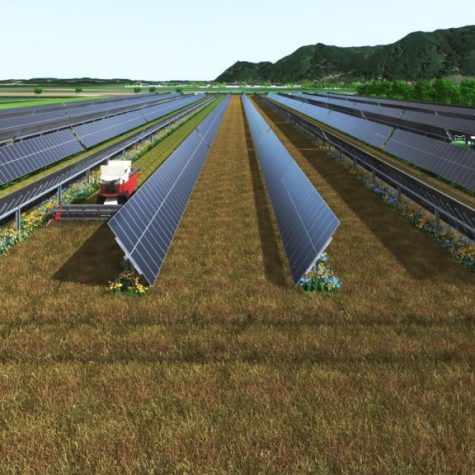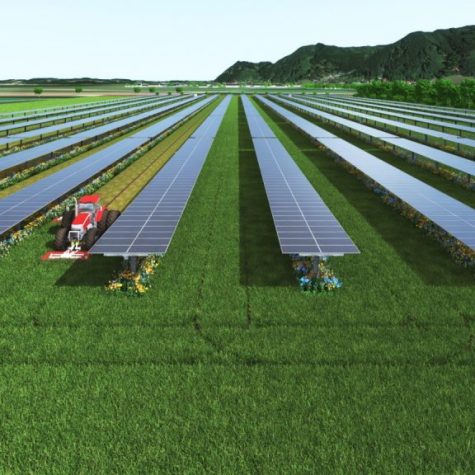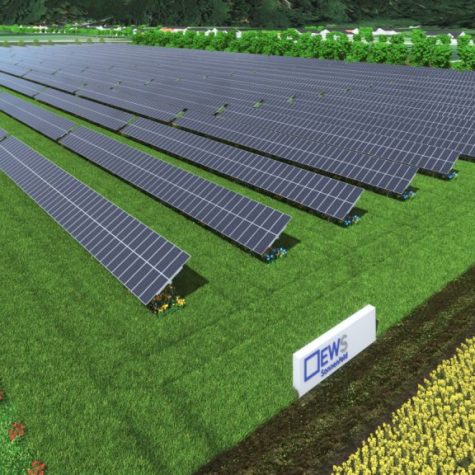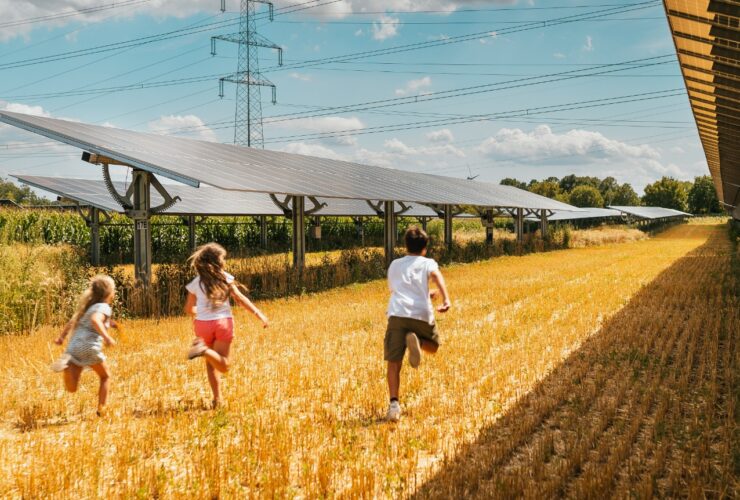

The Sonnenfeld Bruck/Leitha is an agri-PV system whose functional principle is based on the simultaneous harvesting of electricity and food as well as an additional increase in biodiversity. The PV modules are mounted on movable module tables that follow the course of the sun and guarantee mechanical, agricultural cultivation thanks to their ability to swivel. Between the agricultural rows (6, 9 and 12 m cultivation widths are being tested in the research project) there is a 2-metre flowering strip on which various local seed mixtures are being tested or their positive influence on species diversity and biodiversity is being investigated. The flowering strip is therefore located below the PV panels, most of which are mounted on a pivoting axis at a height of 2.8 meters.
Key data of the PV systems:
Area of the entire facility5 ha
Electricity foraround 1,000 households
Area under cultivation for food80 %
Land consumption for PV system2 %
Flower strips for biodiversity18 %
“This project is funded by the Climate and Energy Fund and is carried out under the program “Model and Lighthouse Photovoltaic Projects – Annual Program 2021″.”
The loss of area due to the PV system is absolutely minimized (is less than 2%).
Other advantages of the solar field:
- Additional revenues for agriculture
- Crisis-proof in the event of climate-related crop losses
- Regional, parallel production of electricity and foodstuffs
- Higher social acceptance due to least land loss (2%).
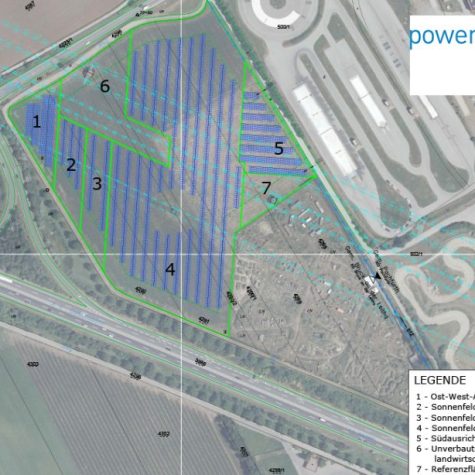
The aim is to use this system to find the perfect production conditions and methods (electricity + agriculture) – adapted to the site-specific a/biotic factors. To achieve this goal, 8 research zones (RZ) will be established:
- 3 research zones with three different row spacings
- 2 research zones with various rigid, south-facing systems.
- 1 research zone with rigid east-west double tables
- 1 Research zone fallow
- 1 research zone agricultural culture
In addition, the specific additional yields when using bifacial modules (as opposed to monofacial modules) and power optimizers are investigated. In times of increasing land scarcity, the Sonnenfeld offers an attractive solution thanks to its dual use and the resulting increase in land efficiency. The increasing droughts caused by the climate crisis are counteracted by shading, reduced evaporation and improvement of the microclimate.
Project partner